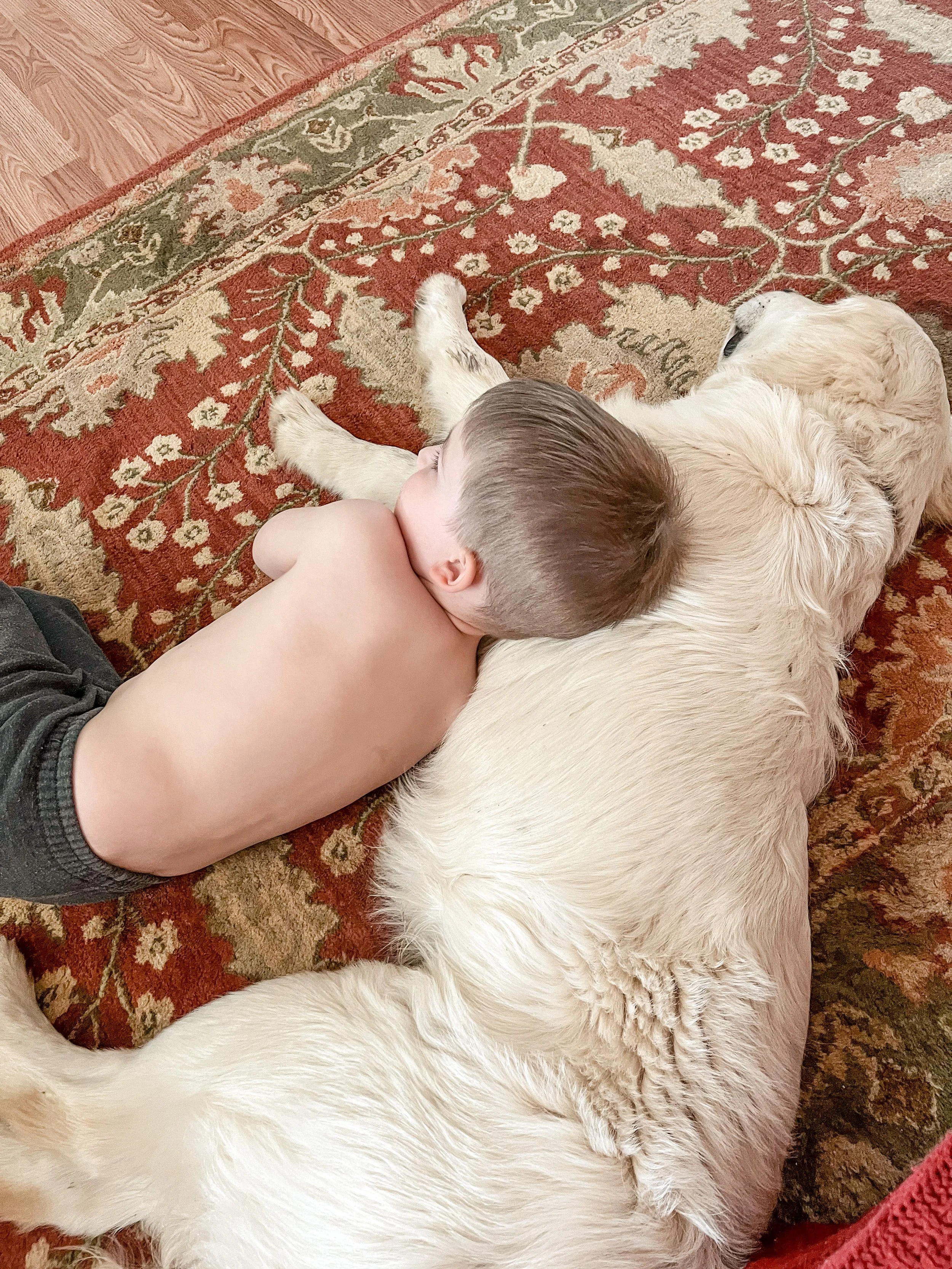
If you grew up with a dog, you probably already believe this is true. Dogs are good for kids. Not just emotionally sweet, but genuinely good for them.
What’s interesting is that science now backs up what families have known for generations. Research continues to show that growing up with a dog can positively impact a child’s immune system, emotional development, physical health, and even social confidence.
If you’re considering adding a Golden Retriever to your home, this isn’t just sentimental. It’s practical.
Let’s talk about what the research actually says.
1. Dogs and Stronger Immune Systems
For years, the cultural narrative pushed hyper-sterile environments for children. But more recent research supports what’s called the “hygiene hypothesis” — the idea that early exposure to everyday microbes actually helps train the immune system.
A large study published in Pediatrics found that children who grew up with dogs in the home had fewer respiratory tract infections and needed fewer antibiotics in early childhood. You can read about that study here:
https://publications.aap.org/pediatrics/article/130/2/211/30007/Dog-and-Cat-Exposure-and-Respiratory-Tract
The National Institutes of Health has also reported that early-life exposure to pets may reduce the risk of developing allergies. Their research summary is available here:
https://www.nih.gov/news-events/nih-research-matters/early-exposure-pets-may-reduce-allergies-asthma
The reasoning is fairly straightforward. Dogs track in outdoor microbes. Children are exposed in small, manageable amounts. Their immune systems learn to respond appropriately instead of overreacting.
That doesn’t mean we ignore hygiene. It means we understand that controlled exposure can be beneficial.
For families who already value outdoor play and real-life living, a dog fits naturally into that environment.

2. Dogs Lower Stress and Anxiety in Children
This is one of the most compelling areas of research.
Multiple studies show that interacting with dogs lowers cortisol (the body’s primary stress hormone) and increases oxytocin (the bonding hormone). The Centers for Disease Control and Prevention summarizes research indicating that children with pets may have decreased anxiety and improved emotional health:
https://www.cdc.gov/healthypets/health-benefits/index.html
There are also clinical studies showing measurable reductions in stress levels when children interact with therapy dogs, particularly in school settings.
Why does this matter?
Because children today experience more pressure, more stimulation, and more comparison than previous generations. A stable, calm dog provides something increasingly rare — steady, non-judgmental companionship.
A dog doesn’t critique. A dog doesn’t compare. A dog doesn’t scroll.
For a child who is overwhelmed, that steady presence is regulating. That’s not just poetic language; it’s physiological.
3. Dogs Increase Physical Activity
Children with dogs move more. It’s that simple.
A study published in Preventive Medicine found that children in dog-owning families were more likely to engage in regular physical activity compared to those without dogs. Walking, playing fetch, running in the yard — it all adds up.
You can view a summary of research on pet ownership and physical activity here from the American Heart Association:
https://www.heart.org/en/news/2019/10/08/dog-owners-get-more-exercise-and-other-health-benefits
Movement in childhood supports cardiovascular health, healthy weight maintenance, bone development, and even cognitive performance. When a dog needs exercise, the whole family benefits.
A Golden Retriever in particular was bred to work alongside people. According to the American Kennel Club’s breed description (https://www.akc.org/dog-breeds/golden-retriever/), Goldens are active, eager to please, and thrive when included in family activities. That combination naturally pulls children outdoors.
Less screen time. More fresh air. More shared experiences.
That’s good for everyone.
4. Dogs Help Develop Responsibility and Emotional Maturity
Beyond physical health, dogs shape character.
Research discussed by the American Academy of Child & Adolescent Psychiatry notes that pets can help children develop empathy, responsibility, and nurturing behavior:
https://www.aacap.org/AACAP/Families_and_Youth/Facts_for_Families/FFF-Guide/Children-And-Pets-075.aspx
When a child helps feed a dog, refill water, brush a coat, or practice obedience, they are learning that their actions have consequences. A living creature depends on them.
That builds competence. And competence builds confidence. In a culture that often entertains children rather than requiring them to contribute, having a responsibility that truly matters is formative.
It teaches follow-through. It teaches consistency. It teaches care. Those are lifelong skills.
5. Dogs Support Social Development
There is also research suggesting that children with dogs may demonstrate stronger social skills and higher levels of prosocial behavior.
A study published in the journal Anthrozoös found that children with strong bonds to pets showed higher levels of empathy and social competence.
Dogs can act as social bridges. They create natural opportunities for conversation in parks, neighborhoods, church settings, and community events. For shy children especially, having a friendly dog at their side can reduce social pressure.
But again, temperament matters.

The Importance of the Right Dog
Here’s where discernment comes in.
The health benefits associated with dogs depend heavily on the dog’s temperament. A stable, well-socialized dog can reduce stress. An anxious or reactive dog can increase it.
That’s why responsible breeding and early socialization matter. The Golden Retriever Club of America outlines stable temperament as a core breed standard:
https://grca.org/about-the-breed/breed-standard/
A Golden Retriever should be friendly, trustworthy, and eager to please. When those qualities are present, the benefits we’ve discussed are far more likely to show up in daily life.
This is one reason I focus so intentionally on balanced drives and steady dispositions in our program. Because we’re not just placing puppies. We’re shaping childhood experiences.
A Biblical Perspective on Dogs and Children
From a Christian worldview, this makes sense. God designed creation with order and purpose. Proverbs 12:10 says, “A righteous man regards the life of his animal.”
When animals are stewarded well, they bless a household.
Children raised around animals often develop patience and attentiveness. There is something grounding about caring for living creatures. It slows a child down. It teaches awareness.
Science may explain the hormones and immune responses, but Scripture already affirms that caring well for animals is part of wise living.

Final Thoughts
How dogs make children healthier is not just sentimental opinion. It is supported by research showing stronger immune systems, lower stress levels, increased physical activity, improved emotional regulation, and greater social development.
But beyond the data, there is something deeper.
The quiet companionship.
The steady loyalty.
The childhood memories that last decades.
If you’re considering a Golden Retriever for your family, don’t just think about having a dog. Think about investing in an environment that supports your children’s physical, emotional, and relational health.
Sometimes the healthiest addition to a home really does have four legs.
And when the temperament is right, the impact can last a lifetime.